

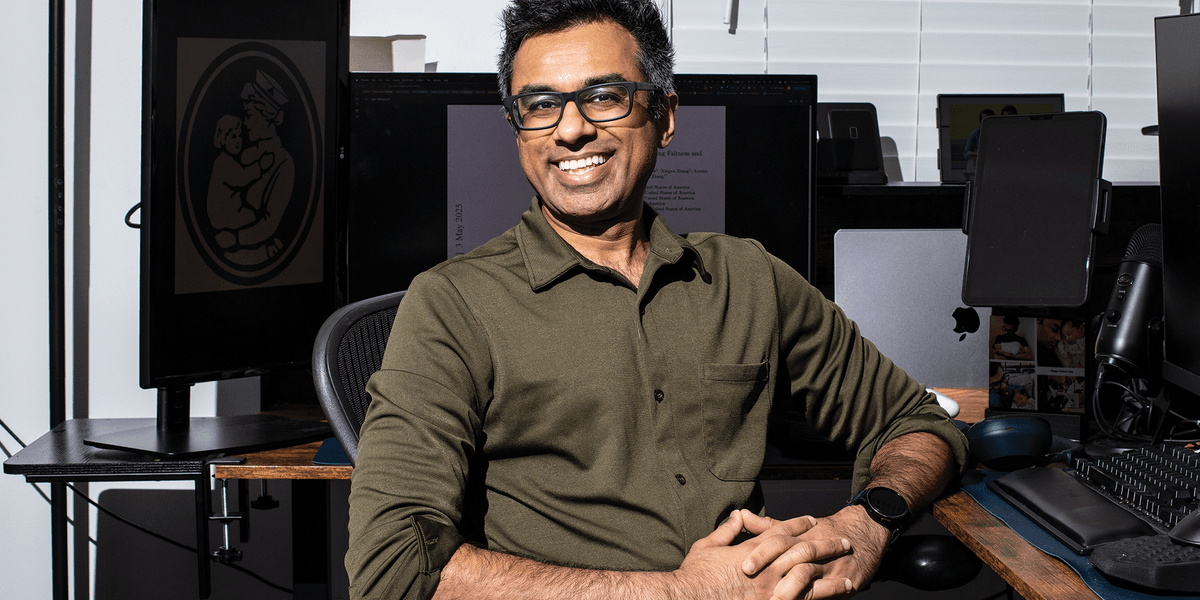
When Boston Youngsters’s Hospital posted a job itemizing for a immediate engineer in 2023, Dinesh Rai determined to use. He didn’t anticipate to get the job.
On the time, immediate engineering was being touted as one of many scorching new jobs created by generative AI. Firms wished individuals who knew the right way to coax the very best solutions from large language models (LLMs) by fastidiously wording directions, supplying examples, and giving the programs personas or different context.
Dinesh Rai
Employer:
Boston Youngsters’s Hospital
Occupation:
Scientific AI Engineer
Schooling:
Bachelor’s diploma in supply-chain administration and advertising sciences, Rutgers Enterprise Faculty; Physician of Medication, Albert Einstein School of Medication
It was an uncommon position for a hospital, however Rai had an uncommon résumé. Whereas he was educated as an emergency doctor, he had additionally taught himself to code simply earlier than coming into medical college. After finishing a fellowship in scientific informatics—which focuses on the intersection of scientific observe and IT programs—he moved into well being expertise.
Boston Youngsters’s introduced him on board in August 2023. Three years later, Rai nonetheless works there. Immediate engineering, nonetheless, has become a much less important part of the job.
When he joined, the expectation was that prompting would turn out to be a job in itself. “Realizing the right way to immediate AI correctly was going to be the job perform of the longer term,” says John Brownstein, chief innovation officer at Boston Youngsters’s.
Early on, the hospital wanted inside experience about the right way to start utilizing AI, Brownstein says. Now, higher fashions have made elaborate prompting much less essential, so the tougher work is constructing AI into precise well being care programs—and figuring out whether or not its solutions will be trusted. Brownstein says the questions they concentrate on today have shifted: “How do you embed these instruments in your day-to-day operations? How do you construct brokers to handle actually every little thing that you just do?”
For Rai, that has meant embracing a job broader than the position that introduced him to Boston. “I’m extra like a scientific AI engineer now,” he says.
Between drugs and engineering
Rai initially studied enterprise as an undergraduate and commenced educating himself to code in 2014 (the identical 12 months he entered medical college), as neural networks and image recognition have been beginning to entice wider consideration. He stored constructing software program whereas coaching as a health care provider. In medical college, for example, he created a platform known as Academius for college kids to trace residency interviews and assemble their rank lists.
For Rai, the attraction of coding was its scale. In emergency drugs, he may make a direct distinction for the person affected person in entrance of him. Software program provided the potential for constructing one thing that hundreds of clinicians may use for a lot of extra sufferers.
His 2021–22 informatics fellowship made the potential for doing that full-time really feel actual. In 2022, Rai took a job at Pieces, a well being care AI firm, the place he led work to convey LLM-based medical summarization into scientific use.
That meant taking a break from working towards drugs altogether. “Stepping away was undoubtedly a tough choice,” Rai says. However he wished to offer the expertise work his full consideration. He has since reactivated his medical license and hopes to return to scientific observe in some capability throughout the subsequent 12 months.
At Boston Youngsters’s, roughly half his day now seems to be like an engineer’s: working with builders, writing code, and advancing tasks from the technical aspect. The opposite half is spent with clinicians, determining what they really want. That mixture has turn out to be the purpose of the job.
Uncovering “scientific doppelgangers”
One venture, known as clinical doppelgangers, is designed to assist docs treating difficult sufferers discover related instances buried within the hospital’s historic knowledge. Medical tips are usually based mostly on massive populations, however at a hospital that handles uncommon and sophisticated ailments, a person baby could not match neatly into the populations represented in revealed research.
The system is being developed to let clinicians establish earlier sufferers with related similarities, look at their trajectories, and see how completely different interventions turned out. It’s not meant to exchange randomized scientific trials. As a substitute, it may present one other supply of proof when a doctor is going through a case for which the revealed literature affords little steerage.
Tasks like that require greater than realizing the right way to ask an LLM the appropriate query. They require understanding what hospital knowledge means, how a clinician will use a solution, and the way an AI system can go improper.
Rai just lately encountered a few of these challenges whereas engaged on one other venture with a scientific group and a improvement group. They have been deciding how a lot of a affected person’s medical report to offer an AI mannequin when asking it to establish findings related to a specific scientific consequence.
Higher fashions have made elaborate prompting much less essential, so the tougher work is constructing AI into precise well being care programs.
Each teams initially favored giving the mannequin entry to extra info, however for various causes. The builders assumed any knowledge level could possibly be helpful. The clinicians assumed the mannequin would acknowledge irrelevant findings and ignore them.
Rai noticed an issue with each assumptions. Clinically, an irregular lab end result or important signal is just not essentially related to the query being requested. And from a technical perspective, an LLM can’t be counted on to acknowledge that irrelevance. If the system asks the mannequin whether or not a given abnormality issues, it might assemble a believable clarification for why it does, even when the report doesn’t help the connection.
“That’s the place the twin perspective has been priceless,” Rai says, “not simply translating between groups, however recognizing when an method that appears cheap from both perspective rests on assumptions we shouldn’t make.”
After the immediate
In drugs, the challenges surrounding the immediate at the moment are extra essential than sharpening the immediate itself. Is the mannequin’s output in line with the underlying knowledge? How ought to its outcomes be evaluated? Will the clinician utilizing it be capable to acknowledge a mistake?
That additionally means listening to clinicians’ expertise. For the platform Rai’s group constructed to draft scientific notes, the clinicians who would go on to make use of the device reviewed a batch of generated notes earlier than something was finalized. Somebody who had cared for a sophisticated affected person within the cardiac intensive care unit for weeks would catch an error much more simply than somebody skimming the chart afterward, Rai says.
Though AI adoption in medicine is surging, some well being care professionals nonetheless have concerns about its use. “I feel some skepticism is wholesome, and we don’t attempt to speak folks out of it,” he says. The group instructed clinicians up entrance that it was a generative AI device meant to help their judgment, not substitute their very own evaluation of the chart. “Folks belief it extra once they’ve seen its errors than after we simply inform them it’s good.”
An evolving profession
The evolution of Rai’s position displays how shortly AI-focused jobs can change, so Rai is cautious of telling folks all in favour of careers like his to grasp any specific device. For individuals who need hands-on engineering jobs, fundamental programming skills still matter. Some understanding of machine learning is helpful, as is expertise constructing and testing programs. However not each clinician who needs to work with AI must turn out to be a database architect or take a deep dive into algorithms.
What Rai considers indispensable is area information. Within the medical subject, meaning understanding how well being care workflows function, how electronic health record data is created, what that knowledge truly represents, and the place care breaks down.
Which may be the extra sturdy lesson from a profession that briefly carried one among AI’s buzziest job titles.
“The worth isn’t simply realizing the right way to get a solution from a mannequin,” Rai says. “It’s realizing what context it wants and whether or not that context helps the reply we’re asking it to offer.”
From Your Web site Articles
Associated Articles Across the Internet
