

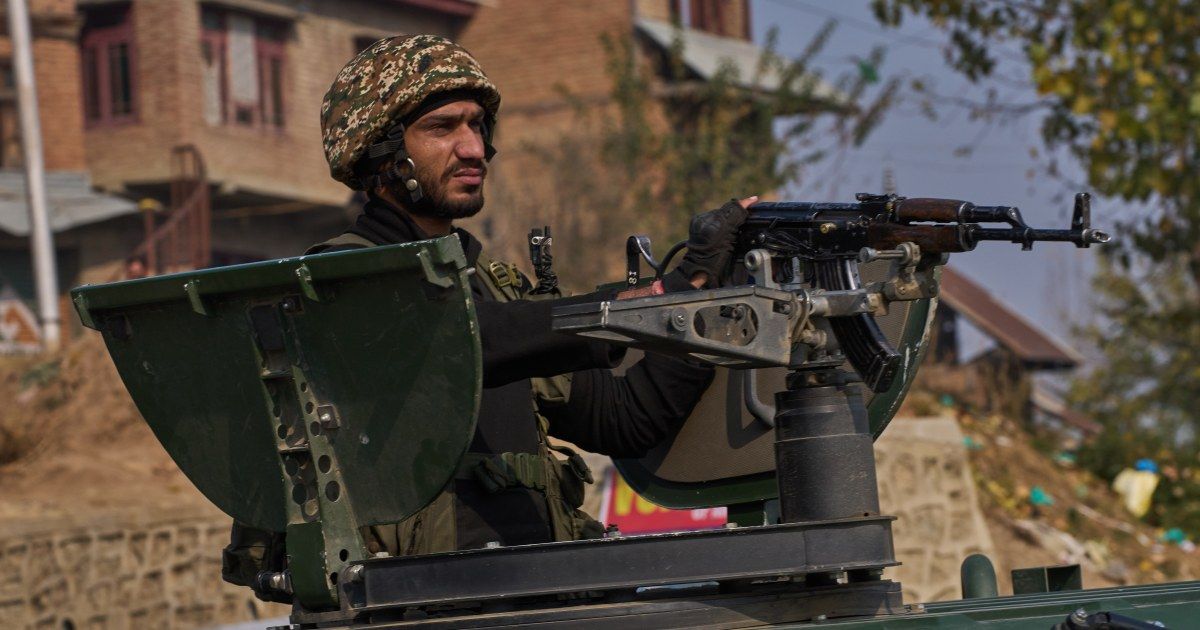
Kulgam and Srinagar, Indian-administered Kashmir – After a seven-day search, Indian safety forces trapped Mohammad Lateef Bhat in a mosque in Zangalpora village, in Indian-administered Kashmir’s Kulgam district.
A gunfight broke out and Bhat was killed on November 18. Described as a commander of the Lashkar-e-Taiba (LeT), a Pakistan-based armed group, Bhat was accused of getting shot at troopers of India’s Central Reserve Police Power every week earlier with one other fighter. Three troopers have been injured. His affiliate was additionally killed within the days after that assault.
Nevertheless it was Bhat’s loss of life that grabbed nationwide headlines.
Indian Residence Minister Amit Shah, the nation’s second-most highly effective particular person after Prime Minister Narendra Modi, instructed a public gathering that Bhat had been the final native armed fighter earlier than he was killed.
“This improvement marks a big change within the safety scenario within the [Kashmir] valley. It’s a matter of pleasure for us,” Shah stated. “No Kashmiri youth is at the moment concerned in terrorist actions within the valley.”
Jammu and Kashmir police additionally claimed that it was the primary time for the reason that armed rebel towards Indian rule in Kashmir started in 1989 that the LeT had no native fighters.
However analysts and former safety officers say the armed battle has not gone away however merely modified type.
They level to armed teams working beneath new names, the rise of operatives who stay exterior official militant lists, a rising reliance on overseas fighters and encrypted communications, and a geographic shift of violence from the Kashmir valley in direction of the forests of Jammu within the south.
Israr Khan, a former deputy inspector basic of the Jammu and Kashmir police, described Bhat’s killing as a big victory for safety forces and a serious setback for LeT. However he stated armed fighters may stay energetic with out showing in official police information.
“By way of my expertise, I can say he actually is just not the final militant as a result of there are militants who’re energetic however will not be in police information,” Khan instructed Al Jazeera.
‘Hybrid militants’
Khan was referring to what police name “hybrid militants”, a time period that emerged in Kashmir round 2020 to explain folks whom safety forces say perform assaults whereas remaining exterior official lists of recognized militants.
The time period gained wider prominence in 2021 after police described “terrorists disguised as civilians” and “part-time terrorists”. Safety officers stated such people may stay in touch with militant teams by way of digital gadgets, obtain native coaching and perform assaults earlier than returning to their regular lives, making them tough for safety companies to detect.
Safety analysts on the time steered that the emergence of hybrid militants may mirror a change in militant technique. Quite than overtly recruiting fighters or publicly displaying weapons, militant teams may use individuals who maintained an outwardly regular civilian life, making them much less seen to safety companies.
However the label itself has been questioned. Some analysts and rights activists argue that authorities haven’t clearly outlined who qualifies as a hybrid militant and that the time period may typically be utilized to folks beforehand described as militant sympathisers – or in impact, to painting each Kashmiri as a possible risk.
There’s additionally no single official cumulative determine for folks arrested as hybrid militants in Kashmir. As a substitute, the Jammu and Kashmir Police and different safety companies have reported arrests in particular person operations.
For Khan, the existence of such fighters makes it tough to ascertain whether or not Bhat was really the final native militant working within the valley. “The subsequent 5 to 6 months are essential and the whole lot will change into clear,” he stated, cautioning that new assaults in Kashmir traced to native youth may drive a reassessment.

New names
Past so-called hybrid fighters, Indian safety forces acknowledge that they’ve been challenged by shapeshifting armed teams in recent times. The Resistance Entrance (TRF) and the Individuals’s Anti-Fascist Entrance (PAFF) are armed teams working in Indian-administered Kashmir. Each emerged after India revoked the area’s particular constitutional standing in August 2019.
TRF claimed accountability for the 2025 assault on civilians in Pahalgam, Indian-administered Kashmir, when gunmen killed 26 folks. India blamed Pakistan for the assault, which set the stage for the four-day battle between the South Asian neighbours in Might that 12 months.
Safety companies and counterterrorism analysts regard TRF and PAFF as proxy organisations linked to established Pakistan-based armed teams. They are saying the teams have been fashioned to obscure these affiliations, mission a localised narrative and deflect worldwide scrutiny, together with monitoring by our bodies such because the Monetary Motion Activity Power (FATF).
For analysts, the emergence of such fronts illustrates how armed teams have tailored to a modified safety atmosphere.
Noor Ahmad Baba, a political scientist and former professor on the College of Kashmir, stated claims had been made beforehand of native fighters not becoming a member of armed teams, but assaults had continued intermittently in Jammu and Kashmir.
“Claims of Kashmir being militancy-free have been made after 2019 as effectively,” Baba instructed Al Jazeera. “I’m not suggesting that such a risk is dominated out. Something is feasible, however an evaluation of the bottom realities presents a distinct image.”
He stated this didn’t imply there had been no enchancment within the safety scenario on the bottom. However analysts say that whereas native recruitment in Kashmir may be down, armed violence might be discovering a brand new house to the south, in Jammu.

Shifting geography
In Jammu, armed violence has resurfaced after years of relative calm. Since 2021, no less than 33 folks have been killed, together with 10 civilians. Defence consultants and political analysts have attributed the resurgence to the difficulties militants face within the Kashmir valley due to a more durable safety response, in addition to the redeployment of some troops from Jammu to handle safety issues alongside the border with China in Ladakh.
The lowered safety presence, they are saying, created alternatives for armed teams to ascertain a foothold. Safety officers and analysts say such fighters more and more use encrypted satellite tv for pc telephones and different safe communication instruments, decreasing their reliance on native contacts and making them tougher to hint.
That shift challenges the official narrative that the absence of native fighters within the Kashmir valley marks the tip of militancy. It suggests as an alternative that armed teams have tailored to heightened surveillance and safety operations by relying extra on overseas fighters, safe communications and terrain that’s tough for safety forces to regulate.
Jammu’s dense forests have change into central to that adaptation.
Rashid Rahi, a political analyst, stated the safety scenario differed considerably between the 2 areas due to their geography.
“There are dense forests within the Jammu division, and it’s tough for safety forces to succeed in each inch of them. Consequently, now we have seen a number of incidents in Udhampur and Rajouri, with safety forces typically taking weeks to conduct search operations, leading to lack of lives,” Rahi instructed Al Jazeera.
“Within the hills of Kashmir, we witness an enormous quantity of snowfall, making it tough to infiltrate throughout the border. Nevertheless, infiltration can happen in Jammu, and that could be a massive distinction between the 2 divisions,” he added.
